

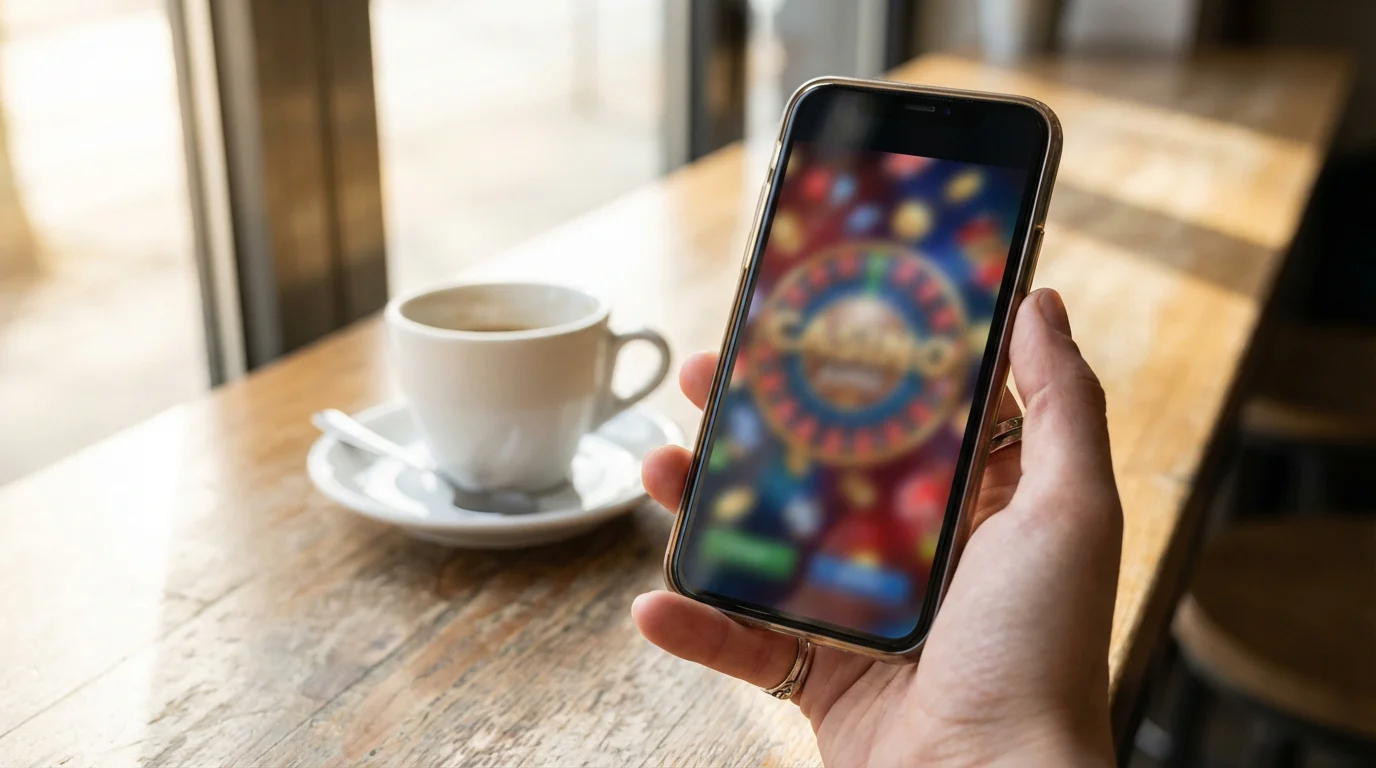
Mobile Compatibility at Non-GamStop Sites
The majority of non-GamStop casinos are built mobile-first. The platforms they run on — SoftSwiss, TechSolutions Group, and other white-label providers that dominate the offshore market — are designed as responsive web applications that adapt automatically to the screen size of the device accessing them. A player loading a non-GamStop casino on an iPhone, an Android phone, or a tablet will see a layout optimised for that screen: vertically oriented menus, touch-friendly buttons, and game thumbnails scaled to finger-tap navigation.
This wasn’t always the case. Five years ago, many offshore casinos were desktop-first operations with mobile as an afterthought — cramped interfaces, broken layouts, and games that loaded slowly or not at all on smaller screens. The shift happened as mobile traffic overtook desktop across the online gambling industry globally. Operators that didn’t adapt lost players. The ones that survived rebuilt their platforms around the device most players actually use.
Game compatibility on mobile depends on the provider rather than the casino. The major studios — Pragmatic Play, Evolution, Play’n GO, NetEnt, Hacksaw Gaming, Push Gaming — develop all new titles in HTML5, which runs natively in mobile browsers without plugins. A slot or table game released in 2026 will almost certainly work on any modern smartphone. Older titles from smaller studios may have compatibility issues, but these are increasingly rare as providers retire Flash-era content.
Live dealer games on mobile require more from the device and the connection. The video stream demands sustained bandwidth (at least 3-5 Mbps for smooth HD playback), and the interface must accommodate both the video feed and the betting controls on a single screen. Evolution and Pragmatic Play Live have invested heavily in mobile-optimised live dealer interfaces, with collapsible menus, portrait-mode streaming, and touch-responsive bet placement. The experience is functional on any recent smartphone but noticeably more comfortable on devices with screens of six inches or larger.
One area where mobile compatibility still lags is account management. Depositing, withdrawing, verifying documents, and navigating bonus terms can feel cramped on a small screen, particularly at casinos that haven’t optimised these backend pages for mobile. If you’re planning to do anything beyond playing games — especially first-time KYC uploads or complex withdrawal requests — a tablet or desktop may be worth using for that specific task.
Browser Play vs Casino Apps
Non-GamStop casinos overwhelmingly deliver their mobile experience through the browser rather than a dedicated app. This is not a technical limitation — it’s a consequence of platform policies. Apple’s App Store and Google Play both restrict real-money gambling apps to operators licensed in specific jurisdictions. Offshore casinos holding Curacao or other non-UKGC licences are generally ineligible for listing. The result is that the browser becomes the default mobile platform for the non-GamStop market.
Browser-based play has practical advantages that offset the absence of a native app. There’s no download, no storage space consumed, no update cycle to manage. The player navigates to the casino’s URL, logs in, and plays. Bookmarking the site to the home screen creates an icon that behaves like an app launcher — some non-GamStop casinos use Progressive Web App (PWA) technology that enables this explicitly, with full-screen mode, push notification support, and offline caching for the interface shell.
The disadvantages are more subtle than most players notice. Browser-based casinos can’t access device-level features as effectively as native apps — biometric login (fingerprint or face recognition) may not work unless the casino specifically integrates it through the browser’s Web Authentication API. Push notifications for promotions require the player to grant browser notification permissions, which many people instinctively decline. And the browser’s address bar consumes screen real estate that a native app would reclaim, though full-screen mode in most mobile browsers eliminates this issue.
A small number of non-GamStop casinos do offer downloadable APK files for Android — sideloaded apps installed outside of Google Play. These bypass the Play Store’s restrictions but introduce their own concerns. APK files from unverified sources carry security risks: malware, data interception, or trojanised versions of the casino app. If a non-GamStop casino offers an APK download, verify that the file is served from the casino’s official domain (not a third-party site) and check the file’s certificate before installing. For most players, browser play is simpler and safer.
Touch Interface and Gameplay Experience
Playing casino games on a touchscreen changes the interaction model in ways that affect both the experience and the risk profile. On desktop, betting is mediated by mouse clicks — a deliberate, slightly distanced action. On mobile, betting is a tap. The physical immediacy of touching a screen to place a wager collapses the gap between impulse and action. Spin buttons are large, colourful, and positioned for thumb reach. The design is intentional: every element of a mobile casino interface is optimised to make the next bet as frictionless as possible.
For slot games, the mobile experience is often superior to desktop. Portrait mode fills the screen with the reels, the spin button sits naturally under the thumb, and the visual impact of cascading wins and bonus animations is more immersive on a handheld device. Quick spin and auto-play features are prominently accessible, and game information (paytable, RTP, bet adjustment) is available through a hamburger menu or a tap-to-expand panel.
Table games and live dealer games are more mixed on mobile. Blackjack and baccarat translate well — the decision interface is simple (hit, stand, bet Banker/Player) and the visual field is compact. Roulette requires more precision: placing bets on a mobile roulette table means tapping small numbered squares, and misplaced bets are easy to make on a 5-inch screen. Most mobile roulette interfaces include a bet confirmation step and a zoom function to mitigate this, but the experience is less precise than desktop play.
Battery drain and data consumption are practical considerations for mobile sessions. Live dealer games consume the most resources — 30 to 60 minutes of live streaming can drain a noticeable percentage of battery and consume several hundred megabytes of mobile data. Slot play is lighter on both counts. If you’re playing on mobile data rather than Wi-Fi, be mindful of your data allowance; a heavy live casino session on 4G or 5G can accumulate data charges quickly on capped plans.
Mobile-Exclusive Bonuses
Some non-GamStop casinos offer bonuses specifically for mobile players — additional free spins for depositing via mobile, enhanced match percentages for mobile first deposits, or promotional codes that only activate when entered from a mobile device. These offers exist because casinos value mobile players: they tend to play more frequently (short sessions throughout the day rather than a single desktop session), and their lifetime value to the operator is generally higher.
The conditions attached to mobile-exclusive bonuses are identical in structure to standard bonuses: wagering requirements, game contribution rates, maximum bet limits, withdrawal caps, and time limits all apply. The bonus is mobile-exclusive in how it’s claimed, not in how it’s cleared. Winnings from a mobile bonus can usually be wagered and withdrawn from any device.
Push notification promotions are another mobile-specific channel. Casinos that use PWA technology or have Android APK apps can send push notifications about time-limited offers — happy hour free spins, flash deposit matches, or tournament entries. These notifications are designed to trigger immediate action, which is both their utility (you don’t miss the offer) and their risk (the offer is designed to prompt an unplanned deposit). Treat push notification promotions with the same scrutiny you’d apply to any bonus: check the terms before claiming, and don’t deposit more than you planned simply because the notification made it feel urgent.
Casino in Your Pocket
Mobile access to non-GamStop casinos means the casino is available wherever the player is — on the commute, during a lunch break, in bed at midnight. That accessibility is the product’s strongest selling point and its most significant risk factor. The friction that once separated the impulse to gamble from the act of gambling — driving to a casino, waiting for a desktop to boot, finding a private moment at home — is eliminated entirely. A single thumb tap opens the lobby.
The convenience is genuine. Mobile play fits around life in a way that desktop gambling doesn’t. Short sessions between tasks, a few spins while waiting for a train, a live dealer hand during a quiet evening — the flexibility is real and, for disciplined players, perfectly manageable.
The risk is equally genuine. Without the UKGC’s mandated session time alerts, reality checks, and affordability prompts, the player at a non-GamStop mobile casino has no external mechanism interrupting play. The session can extend indefinitely, the deposits can stack without warning, and the line between recreational play and compulsive behaviour can blur faster on a device you carry everywhere. Set deposit limits, use a session timer on your phone if the casino doesn’t offer one, and respect the boundaries you set before unlocking the screen. The casino is always in your pocket. The discipline has to be too.
Find more mobile guides at gamesnotongamstop. Also read our non-Gamstop casino software providers.