
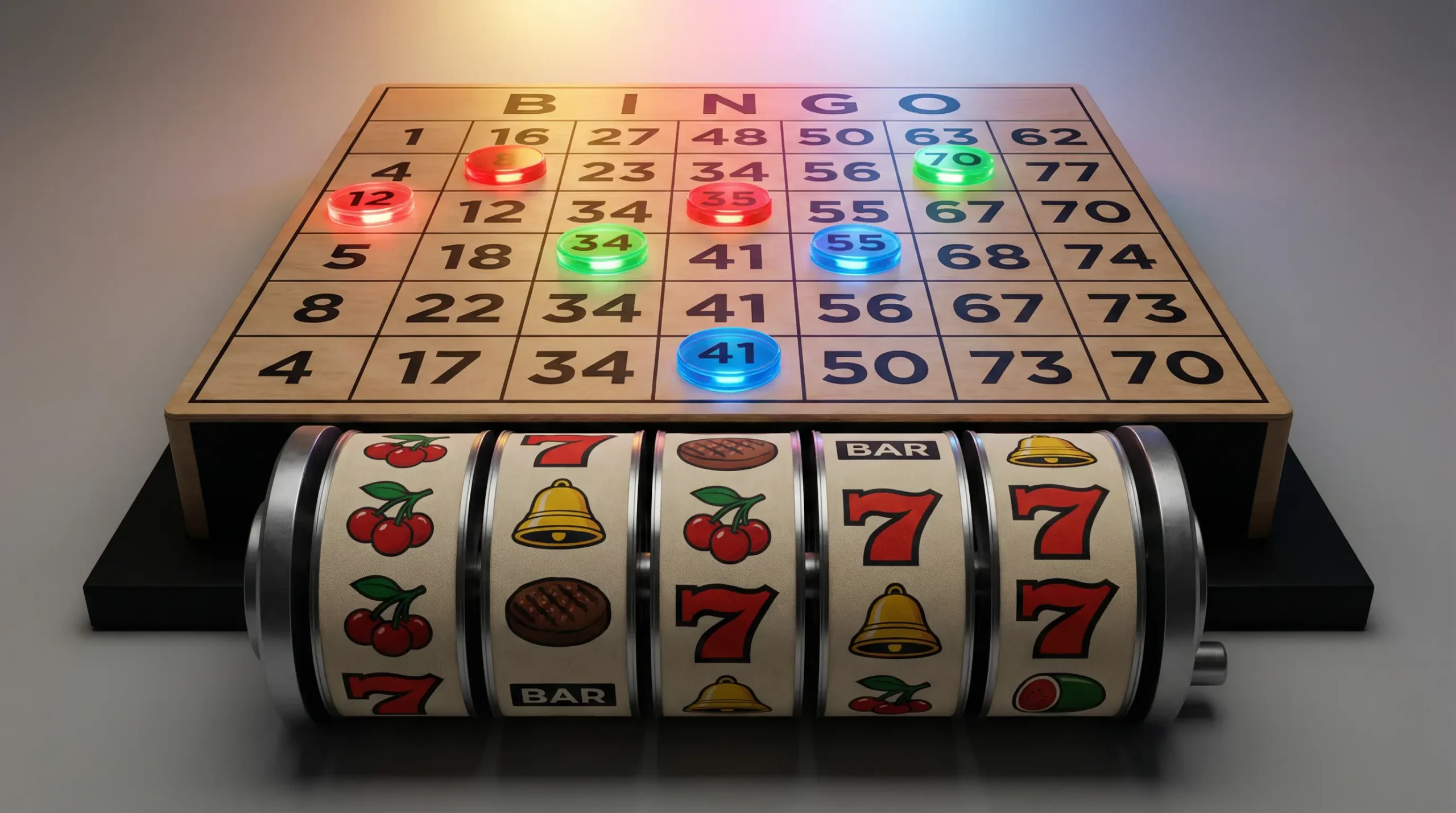
The Slingo Mechanic Explained
Slingo fuses a 5×5 bingo grid with a single-row slot reel. You pay a stake to start the game, the reel spins a set number of times (usually 10 or 11 spins), and each spin reveals five numbers or special symbols. If a revealed number matches one on your grid, it’s marked off. Complete a line — horizontal, vertical, or diagonal — to earn points or trigger a prize. Complete more lines and the prizes escalate. Fill the entire grid for the top payout.
The format originated as a casual browser game in 1994, which makes it older than most online casino products still in active play. Its commercial reinvention came through Gaming Realms (originally Slingo Originals), which developed the mechanic into a regulated gambling product in the 2010s. The transformation from free-to-play into real-money gaming added stakes, pay tables, and the economic structure that casino operators need — while preserving the grid-marking satisfaction that made the original game addictive.
Special symbols on the Slingo reel add tactical depth. Jokers appear in a specific column and can be placed on any number within that column — the player chooses which number to mark. Super Jokers can be placed on any number on the entire grid, offering maximum flexibility. Free Spin symbols award an additional spin beyond the base allocation. Coins and Instant Cash symbols add money directly to the win total. The Devil (or blocker) symbol blocks a position and cannot be used. Each spin presents a micro-decision: which number does the Joker mark? The choice is rarely complex, but it creates a sense of agency that pure bingo lacks.
After the base spins are exhausted, the player is offered the option to purchase additional spins at escalating prices. This is where Slingo’s economics deviate most from bingo and align with slot-like mechanics. The cost of extra spins increases as you approach a full house, and the decision to buy hinges on whether the potential prize justifies the additional investment. This is the game’s primary profit mechanism for the operator: players who chase a near-complete grid will spend more on extra spins than the expected return warrants.
Popular Slingo Titles
Slingo Rainbow Riches adapts the popular Barcrest slot into the Slingo format, combining the familiar Irish theme with grid mechanics. Bonus features mirror the original slot — the Wishing Well, Pots of Gold, and Road to Riches — but are triggered through Slingo line completions rather than scatter symbols. The crossover appeals to players who already know and enjoy Rainbow Riches, offering a different pace and interaction model within a recognisable wrapper. RTP sits at approximately 95.6%.
Slingo Starburst borrows the vibrant colours and expanding wild mechanic from NetEnt’s iconic slot. Starburst Wilds appear on the reel and expand to fill their column on the grid, marking all numbers in that column simultaneously. The mechanic creates satisfying chain completions and adds a visual excitement that the base Slingo format can lack. RTP is approximately 96.7%, making it one of the better-returning Slingo titles.
Slingo Deal or No Deal and Slingo Who Wants to Be a Millionaire bring television game show branding to the format. Both use the Slingo grid as an entry mechanism to a bonus round modelled on the respective show. These titles tend to have lower base RTPs (94-95%) because a significant portion of the theoretical return is concentrated in the bonus feature, which triggers infrequently.
Slingo Originals — the unbranded titles developed by Gaming Realms without a licensed theme — include Slingo Riches, Slingo Extreme, Slingo Classic, and Slingo Cascade. These are often the purest expressions of the mechanic, without the visual noise of brand partnerships. Slingo Extreme adds a “going up” multiplier ladder with competitive prize values for high line counts. Slingo Cascade applies cascading wins (matched numbers are replaced by new ones, creating chain reactions) to the format, borrowing a mechanic popularised by Megaways slots.
At non-GamStop casinos, Slingo availability depends on whether the operator carries Gaming Realms content, which is distributed through several aggregation platforms. Not every non-GamStop site stocks Slingo titles, so check the lobby before depositing if Slingo is a priority.
RTP and Volatility Profiles
Slingo games occupy a middle ground between slots and table games in terms of return. RTPs typically range from 95% to 96.7%, which is comparable to mid-range slots and slightly below the average for modern video slots from top-tier providers. The house edge of 3-5% per game means Slingo is more expensive per unit staked than blackjack, baccarat, or video poker, but cheaper than many feature-heavy or jackpot-linked slots.
Volatility in Slingo is generally medium. The base spins produce a steady stream of small wins (individual line completions), and the prize escalation for higher line counts adds occasional larger payouts without the extreme variance of high-volatility slots. The distribution of returns is more compressed than in a Megaways slot: the gap between the worst and best possible outcomes is narrower, which means sessions are less likely to end in total bankroll depletion but also less likely to produce a spectacular win.
The extra-spin mechanic introduces a variable cost element that complicates straightforward RTP analysis. The published RTP assumes a specific average behaviour regarding extra spin purchases. A player who always buys extra spins when offered will experience a different effective RTP than one who never does. If the price of the extra spin exceeds the expected value of the potential prize, buying it reduces the player’s overall return. The calculation is game-specific and depends on how many lines remain incomplete and what prize level the next completion would trigger.
For practical purposes, treat Slingo as a medium-volatility, medium-RTP game that costs roughly 3-5% of total stakes over extended play. Budget accordingly, and be particularly cautious about extra spin purchases where the cost exceeds a few percent of the remaining potential prize.
Slingo Strategy
Slingo offers more player agency than a slot and less than a table game. The strategic decisions are confined to two areas: Joker placement and extra spin purchasing.
Joker placement strategy is straightforward in principle. When a Joker appears, mark the number that completes the most lines, or contributes to the most nearly-complete lines. If no number completes or advances a line, mark a number in the least-populated row or column to keep options open for future spins. Super Jokers, with grid-wide flexibility, should almost always target the number that directly completes a line, or — if no completion is available — the number in the position where future Joker placements are least likely to reach (corners and edges).
Extra spin decisions require cost-benefit assessment. After your base spins, the game displays the price of an additional spin and the current prize for the next line completion. If the price of the spin exceeds approximately 50% of the next prize increment, buying is generally unprofitable in expected value terms. The calculation is rough but useful: a 5-pound extra spin for a chance at a 4-pound prize improvement is a bad trade. A 2-pound extra spin for a chance at a 20-pound prize improvement is a good one — provided the probability of hitting the needed number is reasonable (check how many unmarked numbers remain in the columns that your grid needs).
The broader strategic point is knowing when to stop buying spins. The escalating price curve is designed to encourage spending more as you get closer to a full house, exploiting the sunk-cost fallacy: you’ve already invested in base spins and early extra spins, so spending more to complete the grid feels like protecting your investment. In reality, each extra spin is an independent purchase with its own expected value, unconnected to what you’ve already spent. If the price no longer justifies the potential return, stop buying regardless of how close the grid looks.
Half Slot, Half Bingo, Fully Addictive
Slingo’s addictive quality comes from the same psychological mechanic that makes bingo compelling: the near-miss. A grid with 23 of 25 numbers marked off feels like it should be completable. The two remaining spaces seem tantalisingly close. The extra spin button glows with possibility. The price might be worth it this time. That tension — the gap between almost-complete and complete — is what makes players buy one more spin, then one more, then one more.
The game knows this. The pricing is calibrated around it. And at a non-GamStop casino, there’s no affordability check or session timer interrupting the escalation. The grid fills at its own pace, the offers appear at their own price, and the player decides alone.
Play Slingo for the satisfaction of marking numbers and the occasional thrill of a full house. Budget for the base game plus a fixed number of extra spins — no more. And when the price of the next spin starts feeling uncomfortable, that discomfort is telling you something worth listening to.